
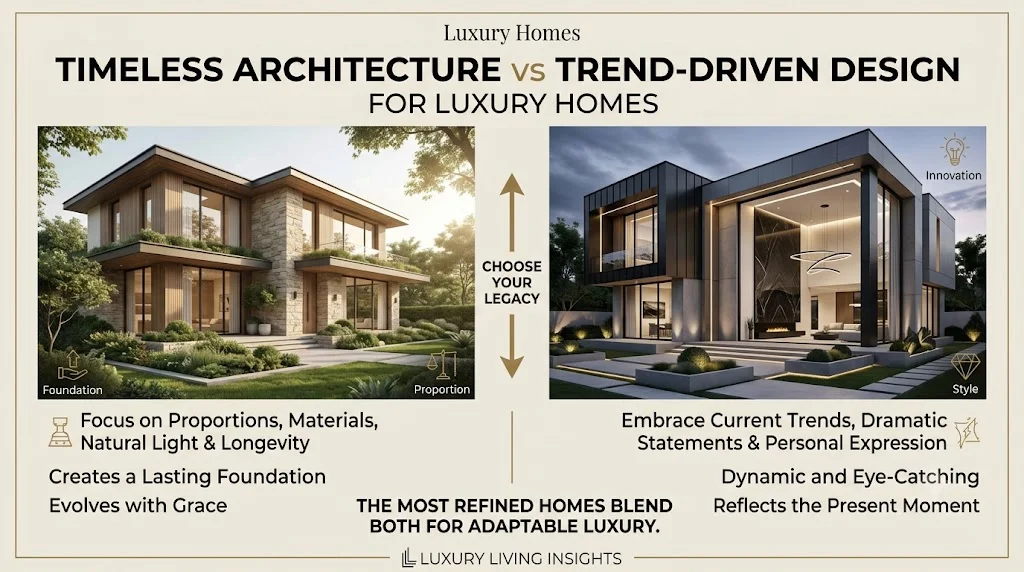
Luxury homes are often associated with impressive facades, statement interiors, expansive glazing, dramatic lighting, and the latest design trends. But a truly exceptional home is not simply a reflection of what is popular today. It is a carefully considered space that continues to feel relevant, elegant, and personal years after construction.
This raises an important question for homeowners planning a high-end residence:
Should a luxury home follow the latest architectural trends, or should it be designed with a timeless approach?
The answer lies in understanding the difference between trend-driven design and timeless architecture — and knowing where each can be used effectively.
What Is Timeless Architecture?
Timeless architecture focuses on proportions, functionality, materials, natural light, spatial planning, and the relationship between the building and its surroundings.
Instead of designing a house around what is fashionable at a particular moment, architects create spaces that can remain visually and functionally relevant for decades.
A timeless luxury home may feature:
- Well-balanced proportions
- Strong architectural geometry
- Natural materials
- Thoughtful circulation
- Abundant natural light
- Indoor-outdoor connections
- Flexible living spaces
- Carefully selected textures
- Landscaping integrated with architecture
- Details that reflect the homeowner’s personality
The objective is not to make the house look old-fashioned. It is to create an architectural foundation that does not depend on short-lived trends.
What Is Trend-Driven Design?
Trend-driven design responds strongly to current architectural and interior design preferences.
Examples can include:
- Dramatic facade treatments
- Extremely minimal interiors
- Statement lighting
- Popular colour palettes
- Large-format tiles
- Curved furniture and walls
- Current smart-home features
- Specific landscaping styles
- Social-media-inspired interiors
- Popular material combinations
Trends can make a home feel contemporary and visually striking. However, trends naturally evolve.
A design element that looks sophisticated today may appear dated several years later.
This does not mean trends should be avoided completely. The key is understanding where trends belong within a long-term architectural vision.
Why Timeless Architecture Matters in Luxury Homes
1. Luxury Is About More Than Appearance
True luxury is not necessarily about adding more decorative elements.
It is about creating a home where every space feels intentional.
The relationship between the living room and garden, the amount of natural light entering a bedroom, the privacy of the master suite, the transition between indoor and outdoor areas, and the way a family moves through the house can have a greater impact than a fashionable finish.
Timeless architecture prioritises these fundamentals.
2. Good Proportions Outlast Trends
Architectural proportions are one of the strongest foundations of a lasting design.
A beautifully proportioned facade can remain elegant even when materials, furniture, colours, and landscaping are updated.
For luxury villas, elements such as:
- Ceiling heights
- Window proportions
- Door dimensions
- Building massing
- Courtyard proportions
- Staircase geometry
- Room volumes
can influence how sophisticated the home feels.
These decisions should be made during the architectural planning stage rather than added as decoration later.
3. Natural Materials Age Gracefully
Materials play an important role in creating a timeless residence.
Natural stone, wood, textured plaster, metal, concrete, glass, and carefully selected finishes can develop character over time.
The objective is not simply to choose expensive materials. It is to select materials that work with the architectural concept, climate, maintenance requirements, and overall character of the property.
In Hyderabad’s climate, material selection should also consider heat, dust, rainfall, maintenance, and long-term durability.
4. Timeless Homes Can Adapt
A luxury home may serve different purposes throughout its life.
Children grow up. Families change. Work patterns evolve. Technology develops.
A thoughtfully planned residence can accommodate these changes without requiring major structural alterations.
Flexible rooms, adaptable furniture layouts, multi-purpose spaces, and well-planned service areas can make a home more future-ready.
This is particularly valuable for large villas and private residences designed for long-term ownership.
Where Trends Can Add Value
Choosing timeless architecture does not mean creating a completely trend-free home.
In fact, contemporary trends can be introduced strategically.
The important distinction is between permanent architectural elements and easily replaceable design elements.
For example, a homeowner might choose a timeless architectural envelope while introducing contemporary furniture, lighting, artwork, fabrics, accessories, or technology.
When preferences change, these elements can be updated without redesigning the entire house.
A useful approach is:
Timeless foundation + contemporary layers = adaptable luxury
This gives homeowners the freedom to enjoy current design ideas without making the entire residence dependent on them.
The Problem With Following Every Trend
A luxury home is a significant long-term investment. Designing it entirely around current trends can create several challenges.
Visual fatigue
Highly distinctive trends can become less appealing when homeowners see the same styles repeatedly across new projects and social media.
Expensive future changes
If trend-driven elements are built into permanent architectural components, updating them later can become expensive and disruptive.
Loss of individuality
Following the same visual trends as everyone else can make a luxury residence feel less personal.
Reduced longevity
A home designed around one particular aesthetic moment may not maintain the same visual relevance as architectural preferences evolve.
For these reasons, trends should be evaluated rather than automatically adopted.
How to Balance Timelessness and Contemporary Design
The strongest luxury residences often combine both approaches.
Keep the architecture timeless
Focus on:
- Massing
- Proportion
- Orientation
- Natural light
- Ventilation
- Spatial planning
- Landscape integration
- Structural quality
These elements form the long-term identity of the home.
Use trends in replaceable layers
Contemporary preferences can be introduced through:
- Furniture
- Decorative lighting
- Soft furnishings
- Artwork
- Accessories
- Interior colours
- Technology
- Select feature walls
These elements can evolve as the homeowner’s preferences change.
Let the homeowner influence the design
A luxury home should not look like a showroom.
The architecture should respond to the family’s lifestyle, routines, interests, privacy requirements, entertaining style, and relationship with the site.
For example, a homeowner who frequently hosts guests may need expansive entertaining areas and seamless connections to outdoor spaces.
Another family may prioritise private courtyards, quiet reading areas, home offices, wellness spaces, or landscaped gardens.
Personalisation is one of the strongest ways to create a home that remains meaningful over time.
Hyderabad Luxury Homes: Why Context Matters
Luxury residential architecture in Hyderabad presents its own opportunities.
From large urban plots to villa developments and private estates on the city’s outskirts, each site has different possibilities and constraints.
Climate, orientation, privacy, surrounding development, landscape, access, and lifestyle should influence the architectural response.
For example, large openings can create beautiful connections with gardens, but their placement should also consider solar exposure, privacy, heat gain, and shading.
Similarly, courtyards, shaded outdoor areas, landscape buffers, and carefully positioned windows can contribute to both visual character and everyday comfort.
A successful luxury home should therefore respond to its site rather than simply copying a popular design from another project.
Timeless Architecture Is Not Traditional Architecture
One common misconception is that timeless design must look classical or traditional.
That is not necessarily the case.
A contemporary residence with clean lines, modern materials, expansive glazing, landscaped courtyards, and minimal detailing can also be timeless.
The difference lies in the design principles behind it.
Trend-driven design asks:
“What is popular right now?”
Timeless architecture asks:
“What will continue to make sense for this home, this site, and this family?”
That difference can significantly influence the long-term character of a residence.
Questions to Ask Before Designing a Luxury Home
Before finalising an architectural concept, homeowners should consider:
- Will this design still feel appropriate ten or twenty years from now?
- Which elements are permanent and which can easily be changed?
- Does the design reflect our lifestyle?
- Does the architecture respond to the site’s orientation and surroundings?
- Are the materials suitable for long-term maintenance?
- Does the floor plan allow the family to adapt over time?
- Are current trends being used selectively?
- Does the landscape form part of the architectural experience?
- Is the home visually distinctive without becoming overly dependent on decoration?
- Does the design feel personal rather than copied from a trend?
These questions can help transform the design process from simply selecting a style into creating a long-term architectural vision.
The Future of Luxury Residential Design
Luxury homeowners increasingly expect more than an impressive facade.
They want homes that combine architecture, interiors, landscape, technology, comfort, privacy, and functionality into one cohesive experience.
This is where an integrated architectural approach becomes valuable.
Instead of treating architecture, interiors, landscape, and site planning as completely separate decisions, they can be considered together from the beginning.
The result can be a residence where materials, lighting, landscaping, views, circulation, and spatial experiences support the same design language.
Final Thoughts
A luxury home does not need to choose between timeless architecture and contemporary design.
The most considered approach is often to establish a timeless architectural foundation and introduce contemporary trends selectively.
Architecture should provide longevity.
Interiors should provide personality.
Technology should provide convenience.
Landscape should provide connection with nature.
And every major decision should respond to the people who will actually live in the home.
For homeowners planning a luxury villa, private residence, farmhouse, or bespoke home in Hyderabad, the objective should not simply be to create a house that looks impressive today.
It should be to create a home that continues to feel refined, personal, functional, and relevant for years to come.
Timeless design is not about avoiding change. It is about creating a foundation that allows change without losing the identity of the home.
Frequently Asked Questions
Is timeless architecture more expensive than trend-driven design?
Not necessarily. The overall cost depends on the project’s scale, materials, specifications, construction quality, and complexity. A timeless approach primarily changes how design decisions are prioritised rather than automatically increasing the budget.
Can a modern luxury villa be timeless?
Yes. Contemporary architecture can be timeless when it is based on strong proportions, thoughtful planning, appropriate materials, natural light, and a clear relationship with the site.
Should luxury homeowners completely avoid architectural trends?
No. Trends can add freshness and personality when used selectively. The key is to distinguish between trends that can be easily updated and architectural decisions that are difficult or expensive to change.
How can interiors be updated without changing the architecture?
Furniture, lighting, artwork, fabrics, accessories, colours, and selected finishes can often be updated while keeping the fundamental architectural planning intact.
What makes a luxury home feel timeless?
Strong proportions, thoughtful spatial planning, quality materials, natural light, landscape integration, functionality, and a design that reflects the homeowner’s lifestyle can all contribute to a timeless character.